Objective
The final SHIFT pilot sought to demonstrate how innovative accessibility and multisensory technologies could be deployed in a regional CH context. Conducted in partnership with the Homeland Museum of Knjaževac under the umbrella of the Balkan Museum Network (BMN), the objective was to evaluate how SHIFT tools can empower smaller institutions and community-based museums to foster cultural participation, inclusivity, and cross-border collaboration across the Balkan region.
User group involved
The user group comprised local community members, including young visitors, elderly audiences, and individuals with disabilities, alongside museum professionals from BMN institutions. By involving diverse participants, the pilot captured a broad spectrum of perspectives on accessibility and digital innovation in smaller-scale heritage settings.
Tools tested
The BMN pilot deployed a selection of SHIFT tools tailored for community-level CH engagement:
Demonstration activity
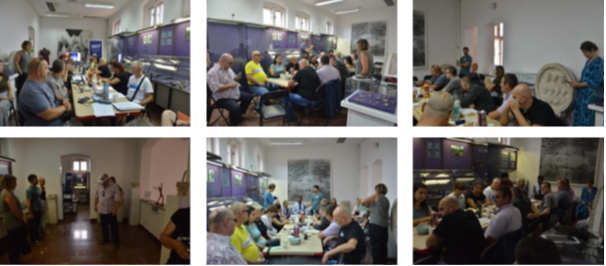
The pilot took place at the Homeland Museum of Knjaževac and was organised as a community event under BMN. Participants were invited to experience the SHIFT tools in hands-on demonstrations, including tactile interaction with replicas of local artefacts, narrated multimedia presentations of regional artworks, and animated historical images. Interactive sessions allowed visitors to query heritage content via the RAG tool, while immersive soundscapes created deeper engagement. Feedback was gathered through participatory workshops, focus group discussions, and questionnaires. The demonstration revealed the strong potential of SHIFT tools for regional museums with limited resources, showing how technology can be scaled to smaller contexts and foster cross-community cultural participation across the Balkan network. A depiction of piloting activities that were carried out in BMN is presented in Figure 11.
3D Print Haptic Desk (by BMN & Homeland Museum Knjaževac)
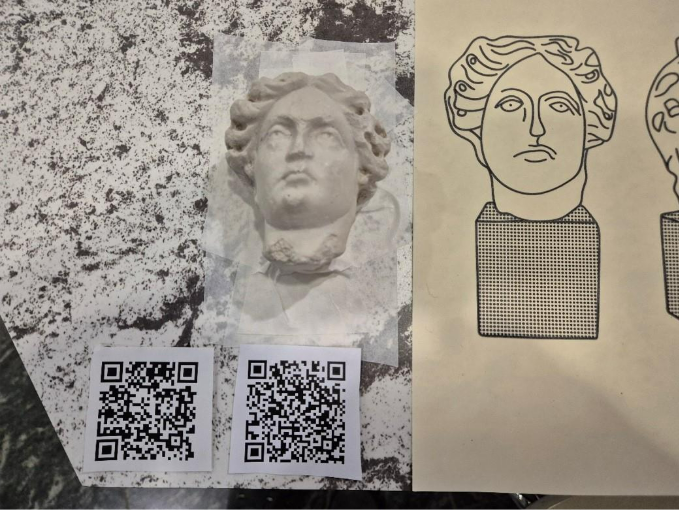
In the vestibule outside the exhibition and lecture hall, visitors had the opportunity to explore a diverse range of cultural objects through haptic perception. For this purpose, the Homeland Museum Knjaževac assembled a demonstration collection comprising relief-like reproductions of two-dimensional artworks and three-dimensional print replicas produced with a 3D printer.
Blind and visually impaired visitors were able to navigate the collection of physical replicas at a dedicated table, either independently or with assistance, experiencing the works by touch. At selected stations, they could access auditory descriptions or, by scanning QR codes, activate video applications designed for sighted visitors.